A Grand Bargain on Tax Reform
Could a Higher GST Unlock a Simpler, Fairer Australian Tax System?
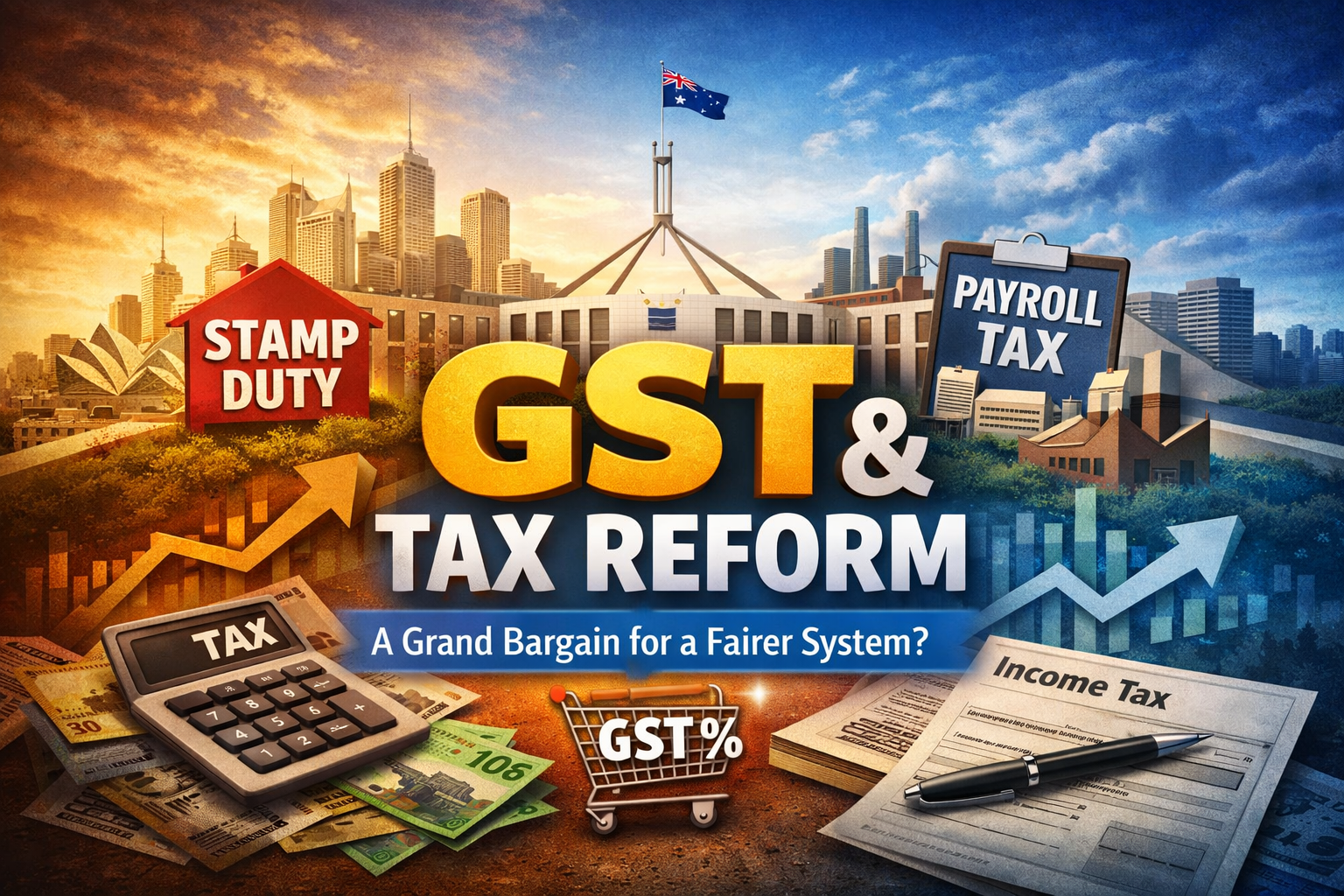
Australia’s tax system was not designed — it evolved.
Layer upon layer of political compromise has produced a structure that is complex, distortionary and increasingly misaligned with a modern, services-driven economy. Stamp duty punishes mobility. Payroll tax discourages hiring. Income tax weighs heavily on productive effort. Meanwhile, the Goods and Services Tax (GST) - broad, stable and difficult to avoid - remains frozen at 10% since its introduction in 2000.
Perhaps it is time for a serious national conversation.
What if Australia pursued a grand tax reform bargain:
Increase the GST rate
Abolish stamp duty and payroll tax at the state level
Reduce federal income tax
Reallocate GST revenue to states to compensate for lost taxes
It would require courage. But it could transform the structure of our economy.
The Structural Problem
Stamp Duty

Stamp duty is widely regarded by economists as one of the most inefficient taxes in Australia.
It penalises:
Downsizing
Relocation for work
Housing market turnover
Economic flexibility
In high-value markets like Melbourne or Sydney, stamp duty can exceed $50,000–$100,000 per transaction. That is not a tax on wealth. It is a tax on movement.
In a dynamic economy, mobility matters.
Payroll Tax

Payroll tax effectively taxes job creation once a business crosses a threshold.
It:
Disincentivises scaling
Encourages artificial corporate structuring
Penalises labour-intensive industries
Falls heavily on services and healthcare
If Australia wants productivity growth and employment expansion, taxing payroll is counterintuitive.
Income Tax

At the federal level, income tax remains the dominant revenue source.
High marginal rates:
Discourage additional effort
Reduce international competitiveness
Increase bracket creep over time
Concentrate the burden on working Australians
Meanwhile, consumption taxes remain comparatively low relative to many OECD economies.
Why the GST Is Different
The GST has structural advantages:
Broad base
Harder to avoid
Stable revenue stream
Efficient to administer
Captures consumption including tourism and imports
At 10%, Australia’s GST is low compared with many developed economies (often 15–20% or higher).
Increasing it - say to 12.5% or 15% - could generate significant additional revenue.
The question is not whether GST could raise revenue. The question is what we would do with it.
A Reform Framework: The Grand Bargain
Imagine a coordinated reform package:
1️⃣ GST Increase
The federal government increases the GST rate and broadens the base modestly, while protecting essential items through targeted compensation.
2️⃣ State Tax Elimination
States commit - through binding intergovernmental agreements - to:
Eliminate stamp duty on property transactions
Phase out payroll tax
Reduce reliance on nuisance taxes
In return, they receive a larger, guaranteed share of GST revenue.
3️⃣ Federal Income Tax Reduction
The Commonwealth uses part of the additional GST revenue to:
Lower marginal income tax rates
Reduce bracket creep
Simplify the tax scale
Potentially lift thresholds for middle-income earners
Economic Impacts
If structured correctly, the impacts could include:
Greater Housing Mobility
Without stamp duty:
Downsizing becomes rational
Families move closer to employment
Labour markets become more fluid
Housing supply is used more efficiently
Stronger Employment Incentives
Removing payroll tax reduces the cost of hiring and scaling.
Improved Productivity
A shift from taxing effort and transactions toward taxing consumption supports growth.
Greater Transparency
Instead of dozens of state-based revenue mechanisms, Australians would see a clearer, simpler structure.
The Political Reality
This reform would require:
Federal-state cooperation
Constitutional and fiscal agreements
Public trust
Strong compensation measures for low-income households
Consumption taxes are regressive if introduced in isolation. But paired with income tax cuts and targeted welfare adjustments, they need not increase inequality.
The real obstacle is not economics.
It is politics.
State governments are reluctant to give up tax sovereignty. Federal governments fear electoral backlash. And voters distrust “tax reform” announcements.
A National Conversation Worth Having
Australia has reached a point where incrementalism may no longer be enough.
Our tax system:
Penalises mobility
Disincentivises employment growth
Concentrates burden on income
Encourages economic distortion
A well-designed GST-led restructuring could rebalance the system toward growth, simplicity and competitiveness.
The real question is not whether GST should rise. It is whether we are prepared to trade inefficient taxes for a more coherent national framework.
Because without reform, the alternative is quiet stagnation - rising bracket creep, rising transaction costs, and continued structural drag on productivity.
The Bigger Question
Tax reform is never popular.
But leadership is not about popularity. It is about designing systems that work for the next generation.
If Australia were to negotiate a serious intergovernmental tax compact - one that replaced stamp duty and payroll tax with a rebalanced GST and lower income taxes - it could be one of the most significant economic reforms since the introduction of the GST itself.
The conversation is difficult.
But it may be overdue.
Quentin Kilian OAM - Thought Leadership