Managing or Leading?

In the realms of organisational dynamics and business management, the distinction between a manager and a leader often shapes the course of a company's success or failure.
While the terms "manager" and "leader" are sometimes used interchangeably, they represent very distinct roles with varying responsibilities, approaches, and impacts on teams and organisations.
“Management is doing things right; leadership is doing the right things.”
Renowned management coach and author Peter F. Drucker used this quote to demonstrate the difference between management and leadership.
Often, it is believed that a good manager is always a good leader. However, that is not true because behaviours that make a person a good manager are often not in favour of innovation.
I would like to take a look at the nuanced differences between being a manager and being a leader, shed some light on their respective characteristics, behaviours, and contributions to the achievement of organisational goals.
In the corporate landscape, the terms "manager" and "leader" are frequently utilised, yet their meanings are often conflated. However, a closer examination reveals that these roles entail different sets of skills, priorities, and methods.
While managers focus on administration and control, leaders inspire and motivate others towards a shared vision. While both roles are important to a business, they are different and not recognising this can have implications for organisational effectiveness.
The Manager
Managers are primarily tasked with overseeing day-to-day operations, ensuring tasks are completed efficiently, and resources are utilised effectively. Their responsibilities typically revolve around planning, organising, coordinating, and controlling activities within a structured framework.
Managers often excel in problem-solving, decision-making, and enforcing policies and procedures. They are adept at maintaining stability, meeting deadlines, and optimising processes to achieve predefined objectives.
However, their approach tends to be more directive and transactional, focusing on immediate outcomes rather than long-term vision.
The Leader
The Oxford Dictionary defines leadership as, “The action of leading a group of people or an organisation.”
Leaders transcend the confines of management roles by inspiring and empowering others to reach their full potential. They articulate a compelling vision, establish and align organisational values, and foster a culture of innovation and collaboration.
Leaders excel in communication, empathy, and relationship-building, cultivating trust and loyalty among team members. They lead by example, exhibiting integrity, resilience, and adaptability in the face of challenges.
Unlike managers who maintain the status quo, leaders challenge the conventional wisdom, driving change and fostering a culture of continuous improvement.
Contrasting Characteristics
While both managers and leaders play crucial roles in driving organisational success, their characteristics and approaches diverge in several key aspects:
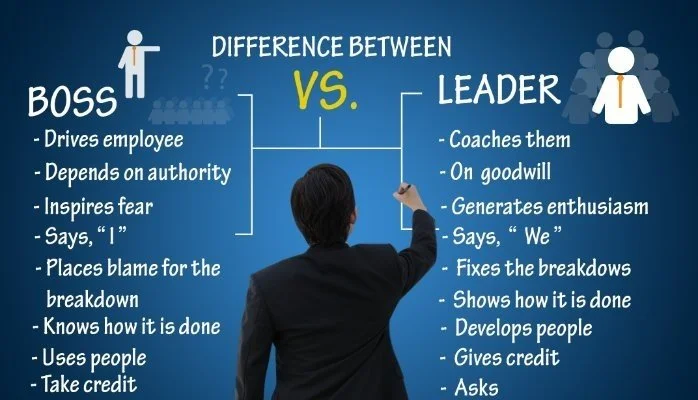
Focus: Managers prioritise tasks, processes, and outputs, ensuring operational efficiency and compliance with established standards. Leaders, however, concentrate on people, vision, and outcomes, inspiring others to transcend current limitations and pursue ambitious goals.
Authority vs. Influence: Managers derive authority from their positional roles within the organisational hierarchy, wielding power to enforce directives and allocate resources. In contrast, leaders earn influence through their actions, expertise, and interpersonal skills, persuading others to embrace change and commit to shared objectives voluntarily.
Risk Aversion vs. Risk-taking: Managers tend to adopt a risk-averse stance, preferring stability and predictability to uncertainty and experimentation. Leaders, conversely, embrace calculated risks, seizing opportunities for growth and innovation while mitigating potential downsides through strategic planning and agile decision-making.
Impact on Organisational Culture and Performance: The distinction between managers and leaders profoundly influences organisational culture, employee engagement, and overall performance:
Culture: Manager-centric cultures may prioritise compliance, hierarchy, and bureaucracy and this can lead to stifling creativity and inhibiting individual initiative. In contrast, leader-centric cultures foster openness, trust, and empowerment, encouraging autonomy, collaboration, and continuous learning.
Employee Engagement: While managers may elicit compliance through supervision and performance evaluation, leaders inspire commitment and loyalty by connecting employees to a shared purpose and providing opportunities for personal and professional development.
Performance: Organisations led by visionary leaders often exhibit higher levels of innovation, adaptability, and resilience, enabling them to thrive in dynamic and competitive environments. In contrast, managerial structures may struggle to respond effectively to disruptive forces or capitalise on emerging opportunities due to their focus on maintaining the status quo.
What Are the Qualities of a Good Leader?
Honesty and Integrity: Leaders value virtuousness and honesty. They have people who believe in them and their vision.
Inspiration: Leaders are self-motivating, and this makes them great influencers. They are a good inspiration to their followers. They help others to understand their roles in a bigger context.
Communication skills: Leaders possess great communication skills. They are transparent with their team and share failures and successes with them.
Vision: Leaders are visionaries. They have a clear idea of what they want and how to achieve it. Being good communicators, leaders can share their vision with the team successfully.
Never give-up spirit: Leaders challenge the status quo. Hence, they never give up easily. They also have, or look for, unique ways to solve a problem.
Intuitive: Leaders have the fortitude to often rely on intuition for making hard decisions, especially because intuition heavily relies on a person’s existing knowledge and life learnings.
Empathic But Objective: This is quite a balancing act. A leader must be emotional and empathetic because it will help them in developing a strong bond with their team. These qualities will help a leader in addressing the problems, complaints, and aspirations of their team members. However, whilst empathy and emotion are important qualities a leader must imbibe, getting clouded by emotions while making an important business decision may impact on those decisions. So, whilst applying empathy, a leader must remain objective.
Intelligence: A good leader must be intelligent enough to arrive at business solutions to difficult problems. A good leader will view issues analytically and weigh the pros & cons before making a decision.
Open-mindedness and creativity: A good leader is someone who is open to new ideas, possibilities, and perspectives. Being a good leader means understanding that there is not always a ‘right way’ to do things. Therefore, a good leader is always ready to listen, observe, and be willing to change. They are also out-of-the-box thinkers and encourage their teams to think the same way.
Patient: A good leader understands that a business strategy takes time to develop and bear results. Additionally, they also believe that ‘continuous improvement’ leads to success.
Flexible: Since leaders understand the concept of continuous improvement, they also know that being adaptable will lead them to success. Nothing goes ‘as per the plan’, so being flexible and intuitive helps a leader hold their ground during complex situations.
Conclusion
In conclusion, while managers and leaders share the common goal of achieving organisational objectives, their approaches and impacts diverge significantly.
While managers excel in efficiency, control, and compliance, leaders excel in vision, inspiration, and innovation.
Recognising and embracing the complementary nature of these roles can foster a culture of balance and synergy, enabling organisations to navigate complexity and uncertainty while maximising their potential for success.
Ultimately, the most effective organisations leverage both managerial expertise and leadership prowess to drive sustainable growth, foster employee engagement, and adapt to evolving market dynamics.
While it is important for a successful business to have a mix of management and leadership, remember that at the top, a good leader can and will manage well, but do not assume a good manager can or will lead.
Quentin Kilian OAM - Thought Leader