The Art of Buying
Why great Businesses & Leaders focus on Creating Buyers - Not just Making Sales
For decades, sales training has focused on one central idea: how to sell.
Pitch better. Handle objections. Close harder.
But the most successful businesses and leaders understand a deeper truth.
“In business, and in leadership, the real skill is not the art of selling. It is the art of creating buyers.”
Selling is not the real objective. Buying is.
The most powerful commercial strategy is not persuading someone to accept a product - it is creating the conditions where they genuinely want to buy it.
This subtle shift in thinking transforms the entire relationship between business and customer.
Many organisations (I would even proffer, most) spend enormous energy trying to sell.
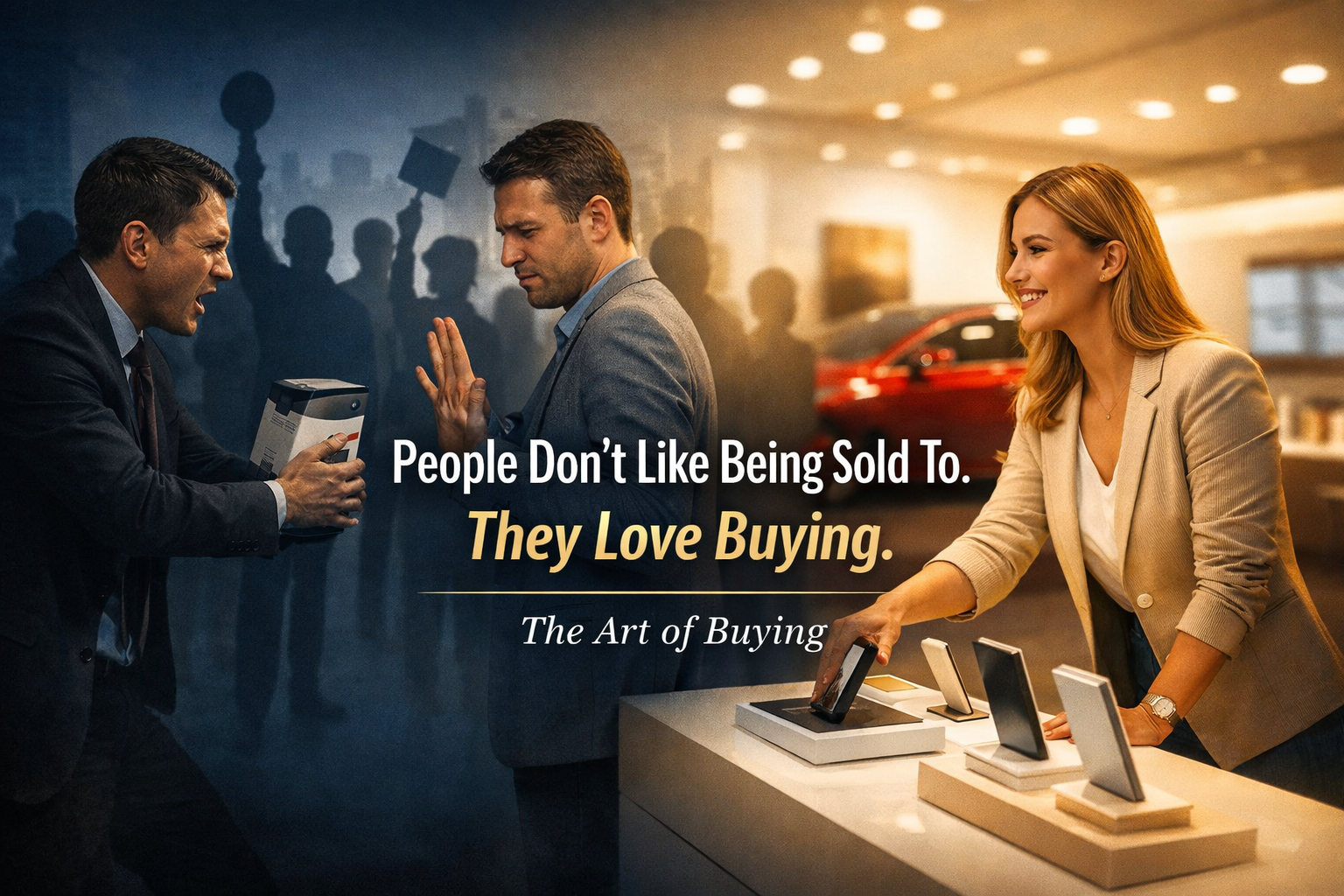
But the most successful businesses understand something far more powerful: People don’t like being sold to. They love buying.
That distinction matters.
The real commercial skill in this equation is not persuasion. It is creating the conditions where customers want to buy.
When that happens, the “sale” almost takes care of itself.
People Don’t Like Being Sold To
Consumers today are more informed, more connected, and more sceptical than at any point in history. They have access to reviews, comparisons, pricing transparency, and peer recommendations within seconds.
When a customer feels they are being pushed, they instinctively resist. Psychologists call this reactance - the natural human response to pressure or perceived manipulation.
We have all experienced it:
The overly aggressive salesperson
The relentless follow-up calls
The pitch that feels scripted rather than genuine
Instead of building trust, these tactics often trigger withdrawal.
People step back. They delay. Or they simply walk away.
The Best Brands Don’t Push - They Attract
Look at some of the world’s most successful companies.
Apple rarely tries to sell you a phone.
Instead, it creates products people actively desire. Customers line up outside stores because they want to buy.
Tesla built a global brand with almost no traditional advertising. The product, the mission and the innovation created buyers.
Luxury brands like Rolex or Hermès take this even further.
They do not chase customers. They create scarcity, aspiration and prestige, and customers pursue them.
The lesson is simple - Desire is stronger than persuasion.
The Shift from Selling to Buying
Great organisations and the best leaders flip the entire equation.
Instead of asking, “How do we sell this?” - They ask, “Why would someone want to buy this?”
David Knox is widely regarded as one of the most influential trainers in the real estate industry, and a professional I have long admired for his views on how business – when done the right way – takes care of itself. His philosophy is that buyers must feel ownership of the decision rather than feeling “sold.”
“Buyers don’t like to be sold, but they love to buy.”
This is arguably Knox’s most famous teaching, and the meaning is simple but profound -
When people feel pressure, they resist. When they feel ownership of the decision, they commit.
“People don’t argue with their own conclusions.”
This is one of Knox’s most powerful psychological insights.
The principle of this, again, is quite simple but too often overlooked or quite simply ignored because the salesperson has been taught to sell, sell, sell.
When the salesperson tells the buyer what to do, you get resistance.
When the buyer reaches the conclusion themselves, you get commitment.
“The more you talk, the less you sell.”
Knox consistently teaches that great agents ask questions instead of delivering speeches.
The best professionals:
listen more than they talk
identify the buyer’s real motivation
allow the buyer to articulate the value
This is the difference between presentation selling and consultative buying.
The Psychology of Influence — Not Pressure
Dale Carnegie, author of How to Win Friends and Influence People, understood human behaviour long before modern sales theory.
One of his most famous insights was, “People are more likely to accept an idea when they feel they have discovered it themselves.”
This is exactly the essence of the art of buying.
When a customer feels ownership of the decision, the need for persuasion disappears.
Helping People Get What They Want
Zig Ziglar framed sales in a similarly simple but powerful way - “You can have everything in life you want, if you will just help enough other people get what they want.”
In other words, the role of the salesperson is not to push a product, but to solve a problem.
When the solution genuinely improves someone’s situation, buying becomes the natural outcome.
Questions Create Decisions
Tom Hopkins, one of the most respected real estate sales educators, emphasised the role of questioning: “The professional salesperson learns to ask questions that lead the prospect to their own conclusion.”
This mirrors the teaching of David Knox: “People don’t argue with their own conclusions.”
Together, these ideas reinforce a simple truth - The best sales conversations feel like discovery, not persuasion.
Sell the Benefit - Not the Product
Brian Tracy summarised another critical element of buying psychology, “Customers buy because they believe a product will improve their life.”
People rarely buy features. They buy outcomes.
Buyers Want Confidence, Not Pressure
When customers decide to buy, they are usually seeking three things:
1. Clarity
They want to clearly understand the product and the value it provides.
Complexity kills buying decisions.
Clarity accelerates them.
2. Confidence
People want reassurance that they are making the right decision.
Trust, credibility, and reputation matter enormously here.
3. Control
Buyers want to feel that the decision is their choice, not the result of pressure.
The moment customers feel ownership over the decision; the likelihood of purchase rises dramatically.
The Role of Trust
Trust is the currency of buying. Trust is the true engine of buying. Customers rarely buy because someone is good at selling.
They buy because they trust:
the product
the organisation
the brand
the person representing it
This is why thought leadership, reputation, and credibility matter so much. People prefer to buy from organisations (and people) they believe understand them.
The Best Salespeople Are Guides
The most effective sales professionals rarely feel like salespeople at all.
They behave more like advisers or guides.
They ask thoughtful questions.
They listen carefully.
They focus on understanding rather than persuading.
By doing so, they help the customer arrive at their own conclusion. And when customers reach that conclusion themselves, the decision to buy becomes easy.
The Long-Term Advantage
The difference between selling and enabling buying is profound.
Selling focuses on the transaction.
Buying focuses on the relationship.
When customers feel they have made a smart buying decision, several powerful things happen:
They become repeat customers
They recommend the product to others
They trust future offerings
They become advocates for the brand
In other words, the organisation moves from chasing sales to building a community of buyers.
The Real Art of Commerce
The art of business is not convincing someone to purchase something they do not need, or might need, or are unsure if they need. It is helping someone clearly see why a product or service improves their situation.
When that happens, selling disappears. Buying takes its place. And the relationship between business and customer becomes stronger, more sustainable, and far more valuable.
Because in the end, the most successful businesses and leaders don’t master the art of selling.
They master the art of buying.