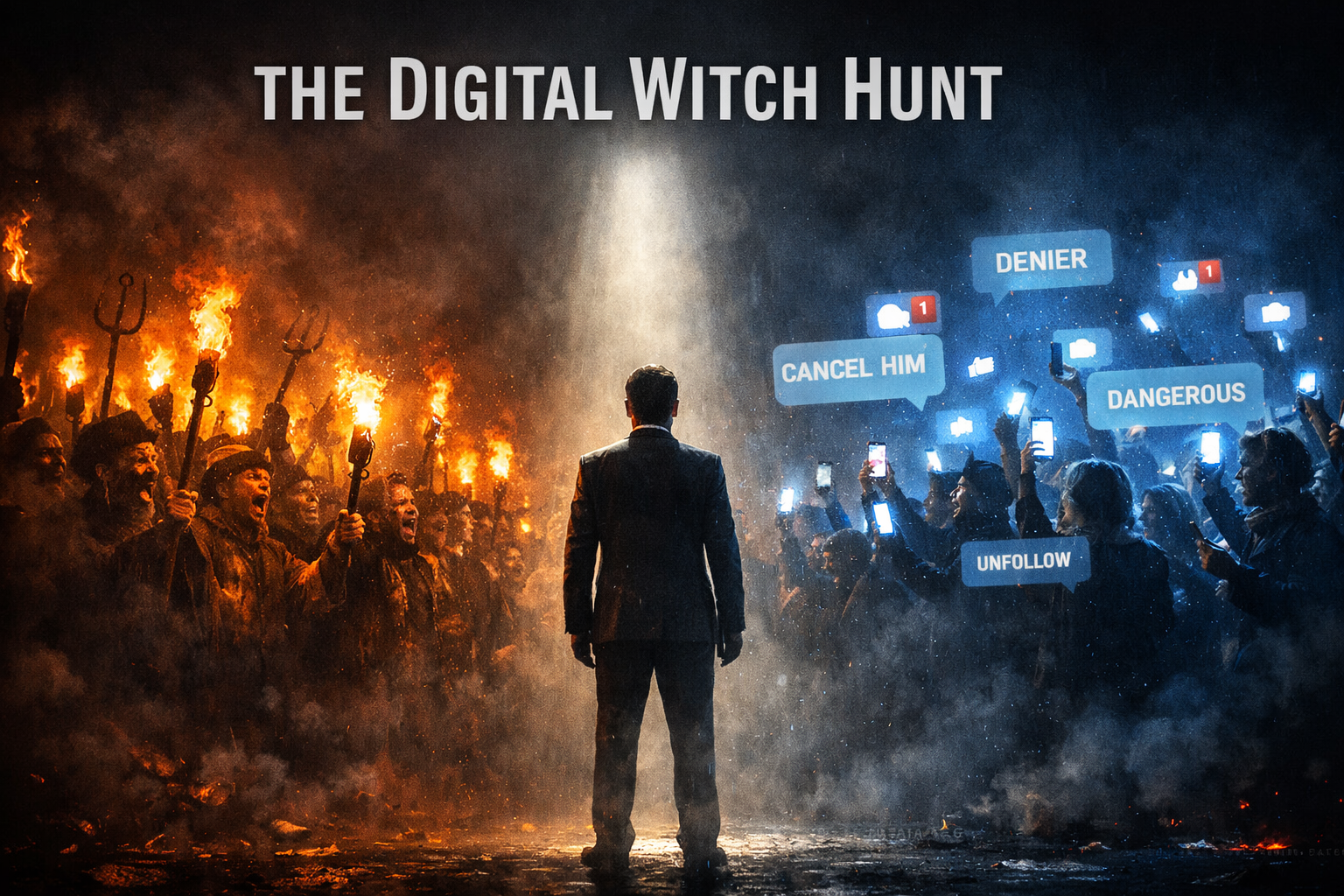
The Digital Witch Hunt
How Social Media Has Recreated the Groupthink of Medieval Times
In theory, we live in the most informed period in human history.
Never before has so much knowledge been available to so many people at the touch of a screen. Entire libraries sit in our pockets. Scientific journals, historical archives, economic data and global perspectives are accessible instantly.
Yet paradoxically, public debate today often feels narrower, more tribal and more intolerant than ever before.
Rather than expanding our thinking, social media has increasingly created a culture that resembles something far older: the groupthink of medieval societies.
In those times, the “mob” determined truth. To challenge the prevailing view could lead to exile, persecution, or worse.
Today the stakes may not be life or death, but the dynamics are strikingly similar.
From Town Squares to Digital Mobs
In medieval Europe, accusations of heresy or witchcraft were often driven by fear, rumour and social pressure. Once the crowd reached a conclusion, dissent became dangerous.
The modern version is not a village square. It is a comment thread.
Social media platforms reward outrage, certainty and emotional reaction. Algorithms elevate content that generates engagement, and nothing engages people more than moral outrage.
The result is a culture where complex issues are flattened into slogans and disagreement is treated not as debate, but as betrayal.
Step outside the approved narrative and a familiar sequence unfolds:
You are labelled.
You are denounced.
You are dismissed.
Words such as “denier”, “extremist”, “conspiracy theorist” or “dangerous” are deployed not as arguments, but as social weapons designed to end discussion.
Once the label is attached, the debate is considered over.
When Questioning Authority Was Dangerous
History provides numerous examples of societies where dominant narratives became untouchable.
During the European witch trials of the 16th and 17th centuries, thousands of people were executed based largely on rumour, hysteria and social pressure. Historian Brian Levack estimates that 40,000 to 60,000 people were killed across Europe in what was essentially a cascade of moral panic.
Once accused, individuals often found that evidence mattered little. The accusation itself became proof.
Earlier still, in 1633, Galileo Galilei was forced by the Roman Inquisition to recant his support for heliocentrism, the now universally accepted idea that the Earth revolves around the Sun. At the time, his views challenged entrenched authority and were therefore treated as dangerous.
History shows that societies frequently react defensively when new ideas threaten established beliefs.
However, what is remarkable today is not that this instinct exists, but that it persists despite unprecedented access to information.
The New Cost of Independent Thought
What makes this phenomenon particularly concerning is that the consequences can extend beyond social media itself.
People have lost jobs.
Businesses have been boycotted.
Reputations have been destroyed.
Often not because someone committed wrongdoing, but because they expressed an opinion that diverged from the dominant narrative of the moment.
This has created a chilling effect across many institutions.
Academics become cautious.
Journalists self-edit.
Corporate leaders avoid public commentary.
The result is a narrowing of the very intellectual diversity that healthy societies require.
The Psychology of Groupthink
The phenomenon itself is not new. It was formally studied in the 1970s by Yale psychologist Irving Janis, who coined the term groupthink while analysing major policy failures such as the Bay of Pigs invasion.
Janis identified several conditions that encourage groupthink:
Pressure toward consensus
Suppression of dissenting opinions
Moral certainty within the group
Stereotyping of opposing views
Self-censorship among members
When these conditions arise, groups stop evaluating evidence objectively. Instead, they reinforce their own assumptions.
Social media amplifies exactly these dynamics.
Digital communities create environments where people are surrounded primarily by those who already share their beliefs, reinforcing consensus while discouraging dissent.
The Paradox of the Information Age
Perhaps the most fascinating aspect of this phenomenon is the contradiction at its core.
We live in an age of unlimited information, yet many people consume a remarkably narrow slice of it.
Algorithms feed us content that aligns with what we already believe.
Online communities reinforce shared narratives.
Contradictory evidence is filtered out or dismissed before it can be considered.
This creates what psychologists call ‘confirmation bias loops’. Environments where individuals become increasingly certain of their position while becoming increasingly hostile to alternatives.
In such environments, debate does not evolve. It hardens.
The Algorithmic Echo Chamber
Modern research increasingly shows that online environments reinforce ideological silos.
A 2011 study by Eli Pariser, who popularised the term filter bubble, demonstrated how algorithmic personalisation shapes the information individuals receive online. Platforms optimise for engagement, meaning users are increasingly shown content that aligns with their existing views.
Subsequent research by Cass Sunstein, a Harvard legal scholar and behavioural economist, has shown that when like-minded individuals discuss issues within closed groups, their views tend to become more extreme over time. A phenomenon known as group polarisation.
In other words, rather than moderating opinion, homogeneous communities often radicalise it.
Social media platforms inadvertently create the perfect environment for this process.
Outrage as a Business Model
Part of the problem is structural.
Social media platforms are not designed primarily to promote truth or nuance. They are designed to maximise engagement and advertising revenue.
Research from the MIT Media Lab (2018) found that false information spreads significantly faster on social media than factual reporting. False stories were 70% more likely to be reposted on X than true ones, largely because they were more emotionally provocative. (Note: This study was conducted when X was known as Twitter)
Outrage spreads.
Nuance rarely goes viral.
This creates a communication environment where simplified narratives dominate complex discussions.
When Evidence Becomes Irrelevant
One of the defining features of modern digital tribalism is the declining role of empirical evidence. Once debates become tribal, evidence often becomes secondary.
Across many debates, from politics to climate policy, economics, public health and social issues, discussions frequently shift away from data and toward identity and allegiance.
People do not ask: Is the argument correct?
They ask: Which side is this person on?
This phenomenon has been widely studied in political psychology. Researchers such as Dan Kahan at Yale Law School have demonstrated what he calls identity-protective cognition: the tendency for individuals to reject factual evidence if accepting it would conflict with the beliefs of the social group they identify with.
In such environments, facts alone rarely change minds. Instead, disagreement can trigger defensive reactions that reinforce existing views even more strongly.
Once a debate becomes tribal, evidence is no longer evaluated objectively. Instead, it is accepted or rejected depending on whether it supports the group narrative.
This is not scientific thinking. It is ideological loyalty.
The Medieval Mindset in a Digital World
The comparison to medieval witch hunts may sound dramatic, but the behavioural patterns are surprisingly similar.
In both cases:
A dominant narrative emerges
Dissenters are labelled and marginalised
Public accusation replaces rational debate
The crowd reinforces its own certainty
History shows that societies periodically fall into these patterns. What is different today is the scale and speed.
Social media allows outrage to spread globally within minutes.
Digital mobs can form in hours.
Reputations built over decades can be dismantled in a single viral moment.
The Culture of Cancellation
The modern consequence of ideological group pressure is often referred to as “cancel culture.”
While the term itself is politically contested, the underlying pattern is widely recognised: individuals who express unpopular opinions can face coordinated social backlash, reputational damage, and in some cases professional consequences.
Sociologists describe this as a form of informal social sanction, where communities enforce behavioural norms through public shaming rather than formal authority.
Historically, this function was performed by churches, guilds or local communities. Today, it often occurs through digital networks of strangers.
Why Open Debate Matters
None of this means every viewpoint is equally correct. But the health of any democratic society depends on something deeper than agreement.
It depends on the ability to question, challenge and test ideas openly.
Scientific progress relies on scepticism.
Economic innovation depends on experimentation.
Political stability requires pluralism.
If dissent becomes socially dangerous, societies risk drifting into intellectual stagnation.
History has shown repeatedly that the greatest breakthroughs often begin as unpopular ideas.
Relearning Intellectual Courage
The solution is not less debate. It is better debate.
That means resisting the temptation to reduce complex issues to moral slogans. It means recognising that disagreement is not inherently malicious.
Most importantly, it means rediscovering a principle that once sat at the heart of Enlightenment thinking: The belief that truth emerges through open inquiry, not enforced consensus.
The real test of a confident society is not how loudly it proclaims its views. It is how calmly it allows those views to be questioned.
The Choice Ahead
We now face an unusual paradox.
Humanity has never had more access to information, yet our public discourse increasingly resembles the tribal dynamics of a far less informed age.
Technology gave us the tools to broaden our thinking. Whether we use them that way is ultimately a cultural choice.
If we are not careful, the digital age may not become the era of enlightenment we imagined.
It may simply become the medieval age - with better internet.